 Scientology pages index | Contact
Scientology membership:
HASI vs IAS - A comparison (1) or
Fundraising, how to go about it and how not to go about it
 (An insider report; also including the Ideal Orgs initiative, started 2004) (An insider report; also including the Ideal Orgs initiative, started 2004) |
 |
(to other Scientology pages) |
>> Do you want to help with preserving the original technology? << Consult my want list here! Please note that words with an asterisk (*) are defined at the bottom of this page! Only first appearances are indicated.
| |
“Giving money or things to a group are both a form of participation and contribution. But while this is an important matter, it does not involve actual action. Thus a contributor of money or objects to a group is yet withholding himself and his time. One should seek contribution of money and things. But the status granted for this is that of patron or associate, not a true member of the group.” |
|
| |
L. Ron Hubbard |
|
| |
(from HCO PL 3 Dec 68 “Gung-Ho Groups, Poltr # 2”) |
|
Scientology membership: HASI vs IAS - A comparison (page 1, index page)
This page will teach you the difference about the various Scientology memberships and how they relate and do not relate to each other.
Index:
 Scientology memberships Scientology memberships
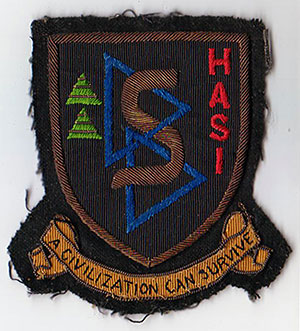
Jacket badge mid-’50s (real size 4⅛' x 4½'),
Saint Hill organization, East Grinstead, England |
You will not find very much information about the HASI organization and what it actually was about in today's Scientology publications. Here and there it is mentioned in passing, but you have to do some digging to be able to put your finger on it. We find some notices of it in ‘What Is Scientology?’ (1992 and forward editions), but we fail to find any specifics about for example why we today have an IAS membership and a while back an HASI membership. Why did it change? When did it change? What are the factual membership differences between these? These and many other questions I had been asking myself for quite a while.
The characters ‘A’, ‘S’ & ‘I’ that we find in both denominations actually mean the very same, it is just that the words have been moving around. But why? More interestingly probably is that the ‘H’, which stands for ‘Hubbard’ disappeared altogether. So why is that?
This page is dedicated to find out more about all these things, the differences, similarities, their purpose and any other information worth knowing. I may hope this will serve others who also have been wondering about this.
I would welcome any criticisms, corrections and or additions warmly!
| The following is a summary of what we have seen thus far: |
|
| |
HAS |
- ‘Hubbard Association of Scientologists’ (1952-54) |
| |
HASI |
- ‘Hubbard Association of Scientologists International’ (1954-77) |
| |
SEF |
- ‘Safe Environment Fund’ (1978-82) (not a Scientology membership per sé though) |
| |
IAS |
- ‘International Association of Scientologists’ (1984-present) |
Not many actually know about this Safe Environment Fund. I actually didn't either. You only find data about this told by persons that were there at the time, or you find it in some obscure (limited distribution) Scientology funded magazines.
HAS & HASI (1952-77)
Scientology as an organization
“The only reason orgs* exist is TO SELL AND DELIVER MATERIALS AND SERVICE TO THE PUBLIC AND GET IN PUBLIC TO SELL AND DELIVER TO.” LRH
(from HCO
PL 31 Jan 83 “The Reason for Orgs”)
The organization
| Entries found in ‘What is Scientology?’ (1978 edition), page 142: |
| |
“1950 |
HUBBARD DIANETIC RESEARCH FOUNDATION, the first organization of Dianetics in US, located until 1951 in Elizabeth, New Jersey. This organization name was shortened by a successor corporation, the Hubbard Dianetic Foundation of Wichita, Kansas. Later it was reincorporated in Arizona and the original name was restored. |
|
| |
1951 |
FIRST TRAINING CENTER. L. Ron Hubbard trained Hubbard Dianetic Auditors in Wichita, Kansas. |
|
| |
|
FIRST OFFICE. Later, the above center of training was moved to Phoenix, Arizona which was the first office of Scientology that L. Ron Hubbard established. In 1954 it became the Hubbard Association of Scientologists International (HASI).” |
|
| L. Ron Hubbard's continued his research through late 1951. Then Dianetics auditors were invited to study a new subject which would address the spiritual side of man, this was Scientology. By early spring 1952, some 15,000 persons were practicing these new principles. A Scientology training center was established in Phoenix, Arizona. |
A Hubbard Association of Scientologists was previously founded offering one technical and one general membership. To keep the members informed of technical breakthroughs and Association news the first Journal of Scientology was published in August 1952 by the Hubbard Association of Scientologists Inc..
(based on information given in ‘What Is Scientology?’ (1992 edition)) |
| Note: In actual fact did ‘What Is Scientology?’ (1992 edition) refer to ‘Hubbard Association of Scientologist International’ (HASI) being founded prior to Aug 1952, then a few paragraphs later it refers to ‘Hubbard Association of Scientologists’ (HAS) in London. At another place it says in the book that a London branch of the ‘Hubbard Association of Scientologists International’ (HASI) was founded on 21 sept 1952. Also this ‘Journal of Scientology’ says on it that it was published by the ‘Hubbard Association of Scientologists Inc.’, note it does not say ‘International’. Based on all the above, the ‘Associate Newsletters’ from 1953 that refer to ‘Hubbard Association of Scientologists’ (HAS), the publication ‘What Is Scientology?’ (1978 edition) which gives us the year 1954, and the actual HASI contract made up in that same year, then I can only conclude this is an error in ‘What Is Scientology?’ (1992 edition). |
Purpose of the ‘Hubbard Association of Scientologists’ (HAS)
“Membership in the HAS is membership in an organization which is determined to free man.” LRH
(from ‘Associate Newsletter 2’, early May 53)
“The purpose of the organization was simply to have a central point of dissemination, where the materials of Dianetics and Scientology could be put out without any great turmoil, turbulence, vias, and to train people in the subject who wanted training, and to give people help and information, who wanted help and information. That is what the HAS was formed to do.” LRH
(from London Public Lecture Series #1 “Goals of Dianetics and Scientology”, given on 8 Oct 55)
Scientology becoming a Church
The first Church of Scientology founded as per the documents was the Church of Scientology of New Jersey on 22 December 1953. The Mother Church (founded on the same day) was the Church of American Science . On 18 February 1954 the Church of Scientology of Los Angeles was founded, later this was to turn to be considered the Mother church. This latest church is referred to in ‘What Is Scientology?’ as the First Church. Why did it become a church?
| |
“A church is simply a building that houses religious activities, a place of learning and attaining knowingness, and knowingness has always been considered sacred lore. As we are dealing with helping Man become more spiritually aware of himself and his family, as well as God, Scientology therefore is a church. In the most ancient tradition, it is symbolic of the thrust towards life of the dynamics or parts of life which total the number eight. We have a road that has been traveled by many. Traveling this road, they have found that they have, indeed, achieved greater success in life and greater happiness in the search for truth. Religion means basically the search for truth. Seeing that, Scientologists in the early ’50s voted that a church be formed.” |
|
| |
(from ‘What Is Scientology?’ (1978 edition), page 198) |
|
I have addressed the founding of the Church of Scientology in detail on my page “Scientology and L. Ron Hubbard - An Introduction”, see chapter “The founding of the ‘Church of Scientology’ and its ‘Creed’”, to consult click here (separate window).
The ‘Hubbard Association of Scientologists’ (HAS) becomes the ‘Hubbard Association of Scientologists International’ (HASI); Holder of the copyrights
HAS (May 1952 - 1954)
“This organization was put together by myself first as the HAS and then there was a flaw in its incorporation papers (which flaw is just simply an attorney's foolishness—he didn't state accurately whether it was a profit or non-profit corporation). In order to get over that we organized the HASI. In other words changed its name to Hubbard Association of Scientologists International.” LRH
(from 8th American Advanced Clinical Course lecture #1 “Introduction: Organization of Scientology”, given on 4 Oct 54)
HASI (10 May 1954 - 10 May 1977)
“Hubbard Association of Scientologists International, the company which operates all Scientology organizations over the world and Saint Hill.” LRH
(from HCO PL 20 Feb 65 “Appointments and Programs”)
| |
A very early HASI membership card issued in May 1954 |
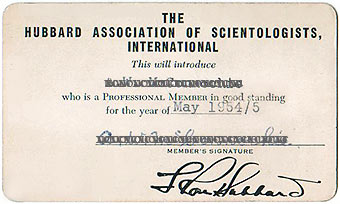 |
|
‘Articles of Incorporation’
| For better understanding of the purpose of this HASI organization one can have a look at some of the articles of the original contract from 10 May ’54: |
| |
“To establish a religious fellowship association for the research into the spirit and human soul and the use and dissemination of findings.
To employ, hire and train persons to teach and to conduct classes; to publish and have published books, articles, letters, papers, magazines and other periodicals; to acquire by purchase, gift, devise or bequest, or any other lawful means, and to hold, mortgage, lease, sell and convey property, both real and personal.” |
|
| With other words, to set up and take any action needed to be able to give out services to the public in an organized manner. |
| There was also a time stipulation in the HASI contract: |
| |
“The time of the commencement of this corporation shall be the date of the filing with the Corporation Commission of Arizona, a copy of the Articles of Incorporation and the filing of a certified copy thereof in the office of the County Recorder of Maricopa County as by law provided, and the termination thereof shall be twenty-five (25) years thereafter unless the same shall be hereinafter extended in accordance with law.” |
|
| Then, without any outer interference, the HASI would expire on 10 May ’79 as per the above. |
The full contract can be consulted here (pop-up window).
Holder of the copyrights (HCO Ltd the main office)
“Few people realize that HCO is actually a separate company. It is the worldwide comm[unication] network of Dianetics and Scientology.” LRH
(from HCO PL 7 Feb 70 “HCO Makes the Org”)
“The HCO is the holder of all copyrights, trademarks, registered marks and the rights of all materials of Dianetics and Scientology.” LRH
(from HCO PL 25 Nov 58 “HCO Board of Review – Function and Practice”)
“All copyrights are made to L. Ron Hubbard, then after ‘my demise’ it says in the franchise, to L. Ron Hubbard, Founder. But all copyrights, marks and rights, by blanket assignment are the property and will remain the property of HCO Ltd the main office. Although the copyright is to L. Ron Hubbard it becomes by that the property of HCO with no further administrative action by reason of existing contracts and franchises.” LRH
(from HCO PL 15 Nov 58 III “Outstanding Copyrights and Marks”)
From the above it appears that L. Ron Hubbard permanently transferred “all copyrights, marks and rights, by blanket assignment” to “HCO Ltd the main office.” The main office of HCO was the Hubbard Association of Scientologists, Inc. (HASI, Inc.) of Arizona, as among other HCO PL 30 Sept 64 “HCO Corporations” confide to us.
HASI Ltd. (1959 - 1965)
| HASI Limited was an initiative to have the Scientology membership organization to be registered as an international non-profit organization. This would render it tax exempt on an international scale. The whole thing was set up and all assets would then have to be transferred from HASI Inc. to HASI Ltd. Shares were also made available to the Scientology parishioner. Not however for the U.S. pending registration of the shares there. In the final end it did not fall through as the government would not grant HASI Ltd. a non-profit status. HASI Ltd. thus was abandoned in 1965. Instead it was transferred back to HASI Inc. of Arizona that was tax exempt. |
| The shares that had been sold were exchanged for a International Membership or if the person had already that the newly established College of Scientology Membership (see HCO PL 14 Oct 65 “College of Scientology”) that gave additional advantages and discounts. If more than one share was bought they would be refunded. |
See for further details ‘The Organization Executive Course: Executive Division 7’ (1974), index at “Corporate Structure” page xix; policy letters on pages 533-552.
| |
“N E W S — N E W S — N E W S |
|
| |
BECOMES HASI LIMITED |
|
| |
GROWING IN SEVEN YEARS from one room at 30 Marlborough Place to a million pound corporation with offices on every continent, the Hubbard Association of Scientologists International has now taken another vital step.
On or about July 30th, 1959, the HASI becomes an all-British limited company with head offices in London. ...
All obligations of HASI will be taken over by HASI Limited.
Four thousand shares only are available in HASI Limited, not just for the British Isles but for the whole world.” |
|
| |
(from ‘News Bulletin’ (undated)) |
|
| |
In this current year of 1960, the interests of Scientology have become so well established throughout the world and its management has been so successful, that it became possible to re-form the organization of Scientology into the Hubbard Association of Scientologists International Limited, a non-profit share company, ..., with the main purpose of this organization being service and research. ... |
|
| |
SUMMARY |
|
| |
This new corporation will be managed by L. Ron Hubbard and Mary Sue Hubbard of Saint Hill Manor, East Grinstead, Sussex, who are the Directors each having one share in the company. ...
Thus we can have as Management L. Ron Hubbard and Mary Sue Hubbard, backed up by trained and tried Executives who have a great deal of organizational experience and thus can ensure a successful programme.
We also have, as Leader in Research, L. Ron Hubbard.
HASI Limited carries forward eight years of successful growth with the same management. It continues to grow rapidly in size and public repute. It needs to continue to grow and expand and therefore we are setting up HASI Limited to go full steam ahead. It could exist and grow without research but with further research we will grow much faster. Therefore we are offering these shares for sale because with more capital we can give more service and thus grow faster with even more positive results.” |
|
Total capital will be at £250,000, with existing shares at 10,000, having a value thus of £25 (or US$75) each. The number of shares released for general sale to Scientologists was, at its release, set at 4,000 shares.
| |
“Dear Madam / Sir,
We have the pleasure to enclose herewith your Share Certificate.” |
|
| |
(from Letter send by HASI Ltd., London (dated, ‘ as per postmark’ 28 Jul 62)) |
|
In the final end the HASI Ltd. didn't fall through for reason of:
| |
“As you may know, the government would not grant HASI Ltd a non-profit status and we are going to remain HASI Inc. of Arizona.
Therefore, HASI Arizona, a bigger company, is offering to buy your share for 1/-* and a Lifetime membership (gratis). and a Lifetime membership (gratis).
This way your are enabled to be ‘aboard’ the organization that contains the bulk of Scientology activity. HASI Arizona is the org where the Main Show is going on and we don't want to leave you sitting in a Side Tent just because of a government's error. ...
As HASI Arizona does not have capital stock, we can't offer to exchange HASI Arizona stock for HASI Ltd stock. But we can and do offer you your Lifetime Membership. This is the way it's done. ...
By law, HASI Arizona, as transferee, has to make a nominal monetary payment. We are therefore offering you the nominal consideration of 1/- for your share ... .
P.S. In the event you have more than one share, you may effect the transfer, and name someone of your choice for the Lifetime membership or HASI Arizona will buy it (them) from you for the nominal consideration of £25.” |
|
| |
(from Letter send to Shareholder (not dated, post stamped 16 Aug 65)) |
|
* 1/- = one shilling. 1/- = one shilling. |
The set price at the time for a Lifetime Membership was set at £25, which thus would make for a fair exchange.
What if you already had a Lifetime Membership? Further solutions came available as time passed on:
| |
“We wish to bring to your attention that the H.A.S.I. Inc. of Arizona offers you, without further dues, a Fellowship of the College of Scientology now under construction at Saint Hill and to buy your share in H.A.S.I. Ltd. for one shilling. H.A.S.I. Arizona is the proprietor of the College. ...
The benefits of a Fellowship of the college are 10% discount on all books and meters purchased through the organization ... . If you have International membership the discount will be increased to 30% on books and 20% on meters.
” |
|
| |
(from Letter send by Hubbard College of Scientology, signed Mary Sue Hubbard (dated 18 Oct 65)) |
|
If bought separately the College of Scientology membership was also set at £25.
The time gap: 11 May 1977 - 6 Oct 1984
| The HASI had gone defunct, and we had to wait another 6½ years before the IAS was initiated. There was no official membership in existence technically. But however things may be, we see that the International Membership offers continued to be published in magazines like “The Auditor”, “Source” and various other magazines during this time period. You still paid your yearly membership (or could pay for your lifetime membership), and pretty much the same benefits were in effect. |
| The only difference was the announcement: “new membership line-up since jan '78”. A Lifetime membership was now referred to as College member, although this had to be renewed each year with a small fee. New was also the Permanent member, which was so to say all-inclusive. (see chapter “Membership advantages - differences and similarities (a chronology)”) |
Coincidentally then we see the ‘Safe Environment Fund’ (SEF) coming into being in 1978 (see next chapter). Various of its characteristics we see implemented in the later established IAS (1984-present).
SEF (1978-82)
‘Safe Environment Fund’ (SEF) (1978-82)
 This was also referred to as Friends of the Safe Environment Fund or the Committee for a Safe Environment. It is said to have been formed in 1978 by the Finance Bureau of the Guardian Office World Wide. In the sense that this was the first of activities that was involved in raising funds for various purposes, that were entirely separate from services taken in Scientology organizations, it could be seen as a sort of forerunner to the IAS. It was “to create a war chest to fight Scientology's enemies” or something like that. This was also referred to as Friends of the Safe Environment Fund or the Committee for a Safe Environment. It is said to have been formed in 1978 by the Finance Bureau of the Guardian Office World Wide. In the sense that this was the first of activities that was involved in raising funds for various purposes, that were entirely separate from services taken in Scientology organizations, it could be seen as a sort of forerunner to the IAS. It was “to create a war chest to fight Scientology's enemies” or something like that.
A late 1979 news issue of the Scientology periodical ‘Co-Motion’ explains it as follows:
| |
Traditionally, there is a role for every man, every woman in the battle for human rights and justice.
In reviewing Scientology's progress in the field, the immense contribution from individual Scientologists and non-Scientologists is at once a vital factor.
Without such contribution, the large majority of achievements, hard won, would never have seen the light of day.
Scientologists and non-Scientologists alike have worked together for the release of mental patients and for humane mental legislation. They have devoted endless hours and effort to seeing an end to violence and abuse in government-associated programmes. In doing so, they have sought a recognition and understanding that man as a human being and a citizen is fully entitled to his beliefs and rights.
Their efforts have been their own reward, for many thousands of people are better off today because of them. What may not have been realized in fighting for these rights and condition is that the Church of Scientology at times cannot, by law, directly assist in helping a private individual in meeting any financial costs incurred either in regular expense or legal defence. |
|
In addition to this, of course, is the burden imposed in meeting its own defence costs, which arise as a direct result of its human rights activities.
In both the Church's own defence and its human rights activities therefore, a traditional role for individual Scientologists has been to assist financially to offset the sometimes enormous costs.
Now, however, due to the ever-enlarging scope of commitment, the establishment of a separate and permanent fund has become a necessity.
The Safe Environment Fund is a trust fund established to aid the cause of justice and human rights for every man. Non-profit making, it was incorporated in Washington D.C., yet is available to anyone of any nationality whose human or civil rights have been violated.
The SAFE ENVIRONMENT FUND is to be permanent, its scope almost unlimited.
We are proud to see the establishment of such a fund and know its benefits over the coming years will be great. Whether Scientologist or non-Scientologist, the SAFE ENVIRONMENT FUND looks forward to your support - in the cause of human rights and justice for man.” |
|
| |
(from ‘Co-Motion’, [late 1979] (issued by the Church of Scientology))
|
|
We get some more details from a promotional letter from England that reads amongst other:
* FSM = Field Staff Member; * HCO = Hubbard Communication Office; * HCO = Hubbard Communication Office; * PR = Public Relations. PR = Public Relations. |
These “eleven Scientologists” referred to in the above were the various staff of the Guardian Office (this included Mary Sue Hubbard) that were indicted for various illegal actions that were uncovered amongst other during the FBI raid on its offices in July 1977. Here these donations towards this SEF were used to amongst other pay their legal fees. It has been said that the SEF was created because of that very occurrence.
Indeed we do find many similarities in this goal setting if we compare this with the in 1984 established IAS. You even got awarded a pin if you joined up with SEF. The SEF is claimed to have been discontinued/dissolved in 1982, thus far however I have no records confirming this. It may however be more likely that the SEF was transformed into the IAS. The defending of these “eleven Scientologists” was not successful, further we have an admitting Mr. Miscavige that the Guardian Office indeed was corrupt and for that reason was dissolved (more about that here, separate window). The association of the SEF with these occurrences may have been thought damaging and undesirable to continue forwarding a purpose as it was original send out for the SEF that today are presented and forwarded by the IAS. Do you have any more data or materials relating to this SEF, then please contact me!
I have a record of the following having been issued: ‘Exchange (safe environment fund)’ issued by Church of Spiritual Technology (Los Angeles). I am not sure what this is about or if it relates to this topic, but it probably does. Anyone have this, then please contact me!
IAS (1984 →)
‘International Association of Scientologists’ (IAS) (7 Oct 1984 - present)
 Then in 1984 another organization came into being. Which was this International Association of Scientologists (IAS). The various websites of Scientology announce that the purpose of the IAS is: Then in 1984 another organization came into being. Which was this International Association of Scientologists (IAS). The various websites of Scientology announce that the purpose of the IAS is:
“To unite, advance, support and protect the Scientology religion and Scientologists in all parts of the world so as to achieve the Aims of Scientology as originated by L. Ron Hubbard.”
It would be of interest that the name L. Ron Hubbard is mentioned here above. Do mind here that the previous official Scientology membership organization had his name included in its name, HASI. Now, why did mention of his name disappear in to this new membership name the IAS? You see, the point is here that if you state “as originated by L. Ron Hubbard” then why oh why do you remove his name?
And rather interestingly they also make the promise: “The IAS was formed to guarantee that Scientologists will always be free to practice their religion and assists Churches of Scientology and Scientologists subjected to religious persecution. The IAS works further to guarantee religious freedom for all.”. (source) (last checked: 10 Mar 2015)
This last sentence here above seems to not limit it to Scientologists alone.
Further some early official announcements:
| From Open Letter send to All Scientologists dated 10 Oct 84: |
| |
“On the 7th of October AD 34* a convention was held at Saint Hill Manor, in England. Scientologists from Churches all around the world came together to discuss ways to speed our expansion. |
|
| |
At this convention a PLEDGE TO MANKIND was made to achieve the aims of Scientology of ‘A civilization without insanity, without criminals and without war, where the able can prosper and honest beings can have rights, and where Man is free to rise to greater heights’, without reservation or any thoughts of personal safety. The purpose of this pledge was to affirm the dedication of Scientologists around the world as a group to this common goal. |
|
| |
In order to achieve the intention of this pledge, it was unanimously concurred that an INTERNATIONAL ASSOCIATION OF SCIENTOLOGISTS be formed which has the purpose to UNITE, ADVANCE, SUPPORT AND PROTECT SCIENTOLOGY IN ALL PARTS OF THE WORLD SO AS TO ACHIEVE THE AIMS AND PURPOSES OF SCIENTOLOGY. |
|
| |
It is the intention of the Association to gather and unite all Scientologists on this planet and create a worldwide, strong true group through the contribution and participation of all Scientologists.” |
|
| From IAS magazine ‘Impact - Introductory Issue’ (early 1985): |
| |
“You will—as a member of this Association—have the privilege of being able to support, advance and protect Scientology and Scientologists in all parts of the world so as to achieve the Aims of Scientology. You will be part of the elite group which is making sure that Scientology will always be there so that every Man, Woman and Child on this planet can go free. |
|
| |
Membership in the Association is now THE official Church membership.” |
|
HASI versus IAS
The relation HASI and IAS examined
One of the most obvious changes was the removal of the name “Hubbard”.
1952:
1954: |
HAS
HASI |
- “Hubbard Association of Scientologists”
- “Hubbard Association of Scientologists International” |
| 1984: |
IAS |
- “International Association of Scientologists” |
Practically the (H)ASI appears to have about the same function as the IAS as its official church membership, it's just that the very same words are put in a different sequence.
“Hubbard Association of Scientologists International” |
|
Hubbard Association of Scientologists International
|
Association of Scientologists International |
International Association of Scientologists |
“International Association of Scientologists” |
|
The question is if there was any connection between the 2 in reality? And what was the reason for removing the name of L. Ron Hubbard? Was L. Ron Hubbard not involved in this new organization? We are actually lacking any referencing from L. Ron Hubbard to this IAS, he does not speak about this anywhere. Would this and the removal of the name of Hubbard indicate that may be someone else was ruling the organization now? Or was his name simply removed because of some legal matters? (whatever they may have been). We are not being informed about this. We are left at our guessing.
It appears that the old HASI simply coordinated in making Scientology available to the public as a service and was the owner of the actual copyrights of Scientology, whereas the IAS basically united all Scientologists into one coordinated group for some other purpose. Definitely not the same, however both do reflect being the actual official Church membership.
| |
“Clarification on HASI memberships |
|
| |
The Church of Scientology has recently adopted the International Association of Scientologists official membership system. All churchmembers are encouraged to join the International Association of Scientologists due to its very pro-survival goals and the many benefits offered from this system. It was never the intention of the Church to not honor the previous HASI membership where this had been secured by the public. Although this HASI membership is no longer available the benefits of this are still available to existing members and will remain so for the duration of their membership.” (quoted from SO ED 2892 Int) |
|
| |
(from IAS magazine “Impact Issue 1” (1985)) |
|
Now if you go through some of the old promo released during 1984-85 you will find that old HASI-members are encouraged to become a member of the IAS, if they did so they were offered a discount on their first year of membership of the IAS. It was also stressed that with the IAS-membership you would receive a 20% discount on all materials and services for any kind of member, whereas the HASI-membership gave a 10%-30% discount (depending on kind of membership), but this was only for materials.
Membership advantages - differences and similarities (a chronology)
(this is all based on information found in several Scientology periodicals and promo from the time)
Please note that HCO PL 22 Mar 65“Current Promotion and Org Program Summary Membership Rundown” which gave a 50% cash purchase discount and credit options was for Scientology staff. The routing on this HCO PL says‘General Non-Remimeo’ which means something similar to ‘limited distribution’, further it says ‘Post Staff Not Public Boards’ which speaks for itself. I mention this as it may appear confusing for those unfamiliar with the routing. The reference is quoted in the ‘Modern Management Technology Defined’ (1976), it is also still in the 1991 release of ‘The Organization Executive Course’ volumes.
| |
| HASI membership (public) |
(1954) |
(from Journal of Scientology 31-G [ca May 54]) |
|
| General membership (cost $8,50 per year), receives magazine ‘Journal of Scientology’ |
| Professional membership, is open to professional auditors only at a cost of $25.00 (£10) per year, receives magazine ‘Journal of Scientology’ & ‘Professional Auditor Bulletins’ |
| Special membership, available to noncertified practitioners at the same price and with the same services as professional membership |
| Founding membership, signifies a founding of the organization itself and is no longer available |
|
| |
|
|
| Associate membership (cost $1,00 - good for life), you received a pin and membership card |
| General membership (cost $8,50 - yearly), receives magazines ‘Ability’ & ‘Certainty’, entitled to 10% discount on books, tapes, etc. |
| Special membership (cost $25,00 - yearly), receives magazines ‘Ability’, ‘Certainty’ & ‘Professional Auditor Bulletins’, entitled to 20% discount on material |
| Professional membership, only available to those who have received training, certified by successful completion and have passed the required tests |
|
| |
|
(Jan 1957) |
(‘Certainty’ Vol. 4, No. 1 [Jan 57] |
|
“Announcing: The New Scientology Membership
From January, 1957, the various grades of General, Special and Professional Memberships are amalgated into one Scientology Membership.” |
| Will receive ‘Certainty’ every month and ‘Professional Auditor's Bulletins’ twice monthly, membership discount at a standard rate of 20% on all the usual discount items |
|
| |
|
(1960)
|
(as per
HCO PL 28 Jul 60 “International Membership Privileges”) |
|
| International membership, receives the ‘PAB’ Magazine monthly, and also
the Continental Magazine (‘Certainty’, ‘Ability’, etc) monthly, receive a discount of 20% on all books,
charts and scales except those priced at 5/- ($1.25) or less, receive a 20% discount on tapes, and also
20% discount on E-Meters |
| Lifetime membership,
receives a 30% discount on books, charts and scales instead of 20% (applies only to books, charts and scales, not to
tapes and E-Meters) |
|
| |
|
(1965) |
from ‘The Auditor’ |
|
| Free 6 months membership |
| Annual membership (cost $15,00) 20% discount for books over $1,25, tape lectures & E-meters, receives magazines: ‘The Auditor’ & ‘Professional Auditors Bulletin’ |
|
| |
|
|
| 10% discount for books, 20% for E-meters |
|
| |
|
(1978)
|
| (new membership line-up since Jan '78) |
|
| Free 6 months membership |
| Annual member (entrance fee: $30,00, for each year thereafter: $15,00) 10% discount on all material (incl. E-meter) |
| College member (replaces ‘Lifetime membership’) (entrance fee: $75,00, for each year thereafter: $15,00) 30% discount on all materials, 20% on E-meters |
| Permanent member (cost $150,00, does not need to be renewed) |
|
|
| |
| IAS membership (1984 - present) |
| Free 6 months membership, receive an introductory membershipcard, receive the magazine ‘Impact Introductory Membership Edition’, entitled to 20% discount on services and materials, membership is not renewable |
| Membership pin, originally this was for free. Today it has to be purchased separately, cost $7,00 |
| Annual membership (cost $300 at its introduction in 1984, today $450), receive the magazine ‘Impact’, entitled to 20% discount on services and materials, and all other benefits and privileges granted by the Association |
| Lifetime membership (cost $2,000 at its introduction in 1984, today $3,000), receive the magazine ‘Impact’, entitled to 20% discount on services and materials, and all other benefits and privileges granted by the Association |
|
|
Since I originally published this page some changes again have occurred. And you can actually read about that for yourself on their own website, see here (external link) (last checked: 5 Mar 2015).
| The Annual membership had gone up to $500.00 U.S. And the Lifetime membership is now set at $5,000.00 U.S. |
| Take note that the previous discount for materials of 20% now was lowered to just 10%. |
| For training and auditing it notes “reduced donation rates”. And “only members of the IAS are eligible for a sliding scale of donations on auditing, Training Scholarships and Professional Rates offered by Churches of Scientology.”. Previously anyone could take advantage of package prices and particular sliding scales. It doesn't say on the website if these “reduced donation rates” account for the previously in use 20% for training and auditing. |
| Then we find the phrase: “Only valid members of the IAS may receive and maintain Scientology certificates per HCO PL 30 July 1962 ‘Certification and Validation requirements’”. One may wonder why this is, because the IAS got nothing to do on these lines. Does it suddenly mean that you did not satisfactory finish your actual validation requirements? Of course not. Still it says here that if you are not an IAS member you may not receive your certificate. |
| Then we have the matter of “maintain” these certificates. According to HCOB 13 Aug 72R “Fast Flow Training” if one “has demonstrated that he can produce flubless results his Certificate is VALIDATED with a gold seal and is a permanent certificate.” LRH. Now, what does this IAS rule try to convey? That your certificate becomes invalid (suddenly you can't audit) if your annual membership expires? As said before, IAS got nothing to do with these things. |
Then it is nice of course that “Members of the Association have preferred admission to and seating at IAS-sponsored events.” where the member is pressured to give more ‘donations’ for no service in return. The non IAS member unfortunately can only hope to this at the local organizations and less favourable seats (in the back). Mind that so-called Patron dinners are by invitation only.
Another noteworthy change is that “Only members of the IAS are eligible to become IAS Field Disseminators and therefore can participate in the Field Disseminator program.”. Well, before that was never a problem, why is it now? Wouldn't this requirement unstimulate people disseminating? Oh, I need to pay in my IAS annual membership first otherwise I can not disseminate Scientology... Obviously this is a wrong message. This is not a benefit, this works rather as an encumberment. If one is a Field Disseminator, being a member of the IAS should come natural, it does not have be listed as a requirement.
As a last item I will address this ‘benefit’: “You have the right to stand and be counted as one who has made a commitment to be part of the only membership which is determined to free man.”. Excuse me??? This is just a plain silly argument. Haven't they ever heard of groups like Civil Rights Defender, Amnesty International, Avaaz and so on? And then Greenpeace èh.., oh that's only for keeping up our natural environment. One may wonder though where man would stand without nature. I am not aware though of IAS ever bringing up a fight for nature.
Fundraising of the IAS versus the HASI fund
“So little by little, using donations you give us
for your service, your training and your
processing, we create little by little areas of
sanity.” LRH
(from ‘The Auditor 55’, 1970 “What Your Donations Buy”)
(1) The outset of the IAS and its gradually increasing activity since its inception
It has to be mentioned here that the IAS was never meant to be a service organization. If you donate to them you don't make a payment to a service to be received. The IAS is involved with all kinds of activities that may improve the conditions of life for various groups of people. It is about exposing the practices of psychiatry, oppose the drugging of children, to stimulate and support education, human rights, the right for freedom of speech, and so on. It supports amongst other this Citizens Commission on Human Rights (CCHR), visit website here (external link) (last checked: 10 Apr 2013).
Essentially the IAS promoted and was asking the Scientology parishioner to service them. Its formation basically introduced and implemented a regular practice of asking for donations, that was not for a particular service you wanted to receive in the Church of Scientology. No, it was for to finance some initiative the IAS had taken upon itself to accomplish. This could be anything from financing advertisements run in a variety of newspapers for various exposures concerning human rights and psychiatry. The printing up of booklets and documentation that would be distributed amongst the population to inform about the dangers of drugs and such, and supporting all kinds of minority groups and educating them. Any such things so we are told.
| At the time of its inception however this wasn't all that evident judging from their activity. The IAS since its establishment in 1984 and during most of the remainder of the ’80s played a rather modest and quiet roll sort of in the background. Pretty much the only time that you were made aware of the IAS (as a Scientology parishioner taking services), that a membership of the IAS would give you a 20% discount on services taken in the organization. Well, this stillness gradually changed since the early ’90s when the IAS got more and more active in the Scientology organizations with giving their special own events that were asking for donations to support their humanitarian projects. Then by the end of the ’90s it had all totally escalated. |
At this time it became very clear to all that the IAS wasn't there to get you active with practice of Scientology particularly, in spite of that it was promoted being “THE official Church membership.” . . |
(2) Fundraising by the IAS
IAS events and IAS status
For the IAS to be able to accomplish various of their aims this practically meant that one resorted to setting up so-called fundraising ‘events’. At such ‘events’ first some information was given about the successes previously achieved, and then some new target would be introduced. This is often done with a video presentation. After these sometimes lengthy introductions donations were being asked for. One approach has amongst other been to speculate upon the goodwill of the prospect. Another was to play games like that if some sum was reached then some person was going to double that. A tactic exercised was that one was simply made to feel uncomfortable if one did not donate, as then you would not be with the group.
The IAS also offers various statuses pending the level (height) of your financial contribution. There is:
| |
| Special Honor |
(for outstanding contribution) |
| Honor Roll |
(helped 20 persons to become new members or who donated up to a certain amount) |
| Special Honor Roll |
(who has assisted in getting 100 others to apply for membership)
Today this is named Senior Honor Roll |
| Founding Member |
(granted to all members who were a lifetime member before 31 Dec ’94) |
| |
| Awarded when having contributed with specific amounts of money:
|
| → |
Sponsor, Crusader, Patron, Patron with Honors, Patron Meritorious, Silver Meritorious, Gold Meritorious. |
| → |
In the early 2000s was added: Platinum Meritorious & Diamond Meritorious. |
| → |
All those that achieved the status of at least Patron before 31 Oct 2004 received an honor status, if you became Patron, you were awarded Founding Patron, etc. |
|
|
| Since this list of these denominations has been extended with new ones, and without doubt this will continue to go on if the situation requires additional variations. For instance when sufficient many persons will have achieved Diamond Meritorious, then new denominations will be required to come into existence to reflect the higher total donation if they continued to donate in excess of that. Which is the reason why we got Platinum & Diamond Meritorious in the first place in these early 2000s. |
| Of course the whole concept behind these denominations is to create a drive for people to give in excess of what they already have donated, and also through their (paid for) ‘status’ earn some sort of respect from fellow Scientologists. Thus by definition this money giving business just doesn't reflect how well you have been behaving morally according to having been a true Scientologist, like we find these laid out for example in the Code of Honour or the Creed of the Church of Scientology. |
‘The Ideal Org’
So about mid-2004 this so-called ‘Ideal Org’ initiative was launched. The main focus was to collect money to purchase property. It didn't effect your IAS status, instead your name could be immortalized on some cornerstone or plate. That is if you donated sufficiently. Pretty much from here on out the focus was redirected to donate for buying property. The IAS purposes sort of slumbered in the background, with only an occasional old-fashion IAS event in where still donations were asked to raise your IAS status. Although this new initiative of Ideal Orgs was and is actively promoted and endorsed by IAS representatives, a difference may be that an IAS representative didn't actually have be present at these. We had now local orgs organizing their own donation events, money that was set aside to purchase their own Ideal Org. Read more in chapter “‘The Ideal Org’ versus the real estate broker”.
Personal experiences and observations of fundraising at IAS events
| For a while this fundraising as practiced by representatives of the IAS was very aggressive and thus a serious downside ... |
| Particularly during the 2nd half of the ’90s things became a kind of well forceful. It turned into something that persons in a rather overly persuasive and repetitive manner were approached to donate funds. People were literally stopped by the door if they wanted to leave and had not ‘donated’ as yet. Often resulting in that a ‘donation’ was made with money that the generous contributor did not actually have, they ‘donated’ just for the sake that they then could finally leave. In following events we then started to see that people (if they had shown up at the event at all) chose to sit on chairs that were closest to the exit, and we could see that somewhat uncomfortable people were waiting for an opportunity to sneak out, as soon as the initial part of the event was over. A funny sight as when the IAS representative was occupied with a public and was looking the other direction, we saw persons quickly standing up and heading for the exit. This crave for money and this sword of Damocles hanging there actually resulted in the end that more and more public purposely chose to stay away from these IAS events. One knew in advance that it would always come to this fundraising game. I personally know about occurrences that people had taken loans, started to work overtime or were taking on extra jobs, just to be able to pay for these ‘donations’. One has to understand that IAS representatives operated and acted along the notion that your money is needed today, and not tomorrow. |
| During this time various persons naturally started to regret that they had given donations (obtained basically by force) and were asking for a refund. All this resulted in some consternation on the lines. Suddenly we saw at this time that this overly persuasive approach was over and done with. Pretty much simultaneously we also find the practice introduced that if one was to donate to the IAS that one was required to sign a slip that said that one understood that this was a donation towards the purposes of the IAS and that a refund therefore could not ever be given. I guess a lesson was learned. |

| Generally within the organization and its members it is just not considered ethical to choose to not donate with money. In fact through the years I have had several IAS money collectors èh.. representatives saying right into my face that I had an ethics problem when I chose not to contribute through hard cash. |
 Incident 1 (2008): Particular rudeness and actions attempted to be taken against my person were experienced when 2 of these IAS representatives (that were not too bright) went for me and I simply said to them up front that it was my understanding that L. Ron Hubbard doesn't recommend money raising barbeque parties, and therefore it was no use trying to persuade me to give money for no service given in return. I also said that I could provide them with the references on that. One of them turned rather quickly aggressive and exceedingly invalidative towards my person, and so I did not wish to further this communication, this I told him. He then repeatedly ordered me to learn my name, but I completely ignored him from here on out. Incident 1 (2008): Particular rudeness and actions attempted to be taken against my person were experienced when 2 of these IAS representatives (that were not too bright) went for me and I simply said to them up front that it was my understanding that L. Ron Hubbard doesn't recommend money raising barbeque parties, and therefore it was no use trying to persuade me to give money for no service given in return. I also said that I could provide them with the references on that. One of them turned rather quickly aggressive and exceedingly invalidative towards my person, and so I did not wish to further this communication, this I told him. He then repeatedly ordered me to learn my name, but I completely ignored him from here on out. |
| This was a series of IAS events and the following week when I visited the 2nd event I was told by another IAS representative that he had received the information that I was ‘enturbulating’ at the previous event and suddenly there was this person here, that I had never seen before in the 20 years I had been a regular in this local organization, summoning me to leave the org premises. I replied that I had not been the enturbulating factor and that he did not have the authority to summon me. “I don't?,” he replied somewhat surprised. “No, you don't!,” I said. |
| It appeared that the Executive Director of this local org didn't even know about it (this person needs to approve such), further no reports had been received of how I supposedly had enturbulated anyone. He assured me that he believed I would receive this report soon. This report however needs to be presented first! (still waiting for it this day) So, I said to him that I was going to stay. More persons interfered, a local org staff, 2 more IAS representatives also joined. There was some commotion, then when I finally said to them that I had no interest to influence other people to not give money, but just don't ask me for a donation, then they suddenly relaxed. Now, isn't that so very interesting! Later on I was congratulated by the Executive Director of this local org of how well I had handled the situation. |
| It is just a very sad thing that people would think that giving money at these events would make you a good Scientologist and refraining from doing so denoting you as some sort of no-good Scientologist by general agreement of some people. You see, money just got nothing to do with that! Each person reserves the right to choose his own way how to contribute or support some cause. I had not been without contribution, but it should either way not be measured or categorized by money given. |

| At these IAS events pretty much as a rule quotations are given out or texts are read aloud that could be interpreted as supporting or convincing people to ‘donate’ money. |
| Incident 2 (ca 2000): At one IAS event the ever popular quotation “Later on, if we make it, what will be your answer to this question? ‘Did you help?’” was thrown about (see ‘The Auditor 9’, Aug 65 “Five Years”, click here, pop-up window). The presentation of the IAS representative basically implied that helping means giving money. His presentation went along and at a point when he forcefully said something like that if you want to help you support the IAS in their projects and go up on to your next IAS status, you don't let it fall on just a few shoulders. Here suddenly the Executive Director voiced: “Right!,” and was looking displeased at me. I accepted this challenge and said aloud: “Where does it say in that reference or any other LRH reference that ‘helping’, equals, or must occur by ‘giving money!’”. And for a moment it was very quiet, then the event went along again. I was not challenged again. |
Incident 3 (early 2000s): I opened my mouth again at another IAS event when I was spoken to by I think the same IAS representative and he asked me if I had anything to say. I did say something along the line that L. Ron Hubbard did not support or recommend this sort of money asking activities. The interesting reaction here came from a Class VI trained auditor in the audience (at one time set up to become the Sr C/S* in this local org), he looked at me with utter astonishment, like if he was saying to me: “Did he just say what I think he said?”. He couldn't manage that I dared to say such a thing aloud in public. He kept looking at me in awe for some time longer.
| By now I had earned a reputation to be able to speak my mind at events if spoken to. |
| Incident 4 (early 2000s): I was invited go come to another such an IAS event that was set up at the local organization. I decided to go there. The evening of the event I sat down on a chair in the front row on the side (I usually did that). Took off my jacket and placed it over the backrest of the chair. Then just some minute before the event was starting a local staff called for me and said she wanted to talk to me. But I said that the event was starting. She insisted, I thought ok then, wondering what was going on, but left my jacket hanging on the chair (preserving my seat). We sat down at the reception where this girl said to me that this event was only for persons that wanted to help the organization. “And...?,” I inquired. Then she said that this event was not for me. “Are you implying that I don't want to help?,” I said. It went forth and back a bit. It finally came down to that I was told that I was not welcome to be at this event, although I had been invited. When I sat there with this girl, another staff came carrying my jacket. It was strongly felt by me that if I insisted joining the event that I would be stopped. Now, isn't this all interesting? At the moment the event commenced I got hand-picked and was basically told to leave. Apparently it was thus feared that I might speak my mind once more which may discourage some person from ‘donating’ money. And I was thinking, haven't these people understood that Scientology is about to get you to speak up? |
Anyhow, it may have been that I succeeded to get some message across as I was never again stopped from joining events by local staff. I did however contribute in various ways, it was just not by giving money. For example when this org moved to another location I singlehandedly sorted out and set up the Qual Library*. As time went on my position appeared fully accepted in this local org this by the public and staff. The Executive Director had changed radically and could even joke about it at events, for example when she invited me to give the first donation, whereupon part of the crowd looked at me and smiled, they all understood.
A last thing I wish to address here is about assumptions that various parishioners had made that this (paid for) ‘status’ will protect this generous money giver from ‘bad things’ happening to them if they in some way foul up or do something that is undesired by those that are in charge of their organization. All I want to say about this is that I have personally seen that it doesn't guard you particularly, not even if you had donated considerably and had a rather high ‘status’. But of course one has to be a bit careful about Diamond Meritorious sort of money givers and celebrities, as action taken against them may create some unwanted bad public relation in turn.
The HASI fund
| According to my understanding as per the data that I have found in regards to the HASI it was not involved with any of the things that the IAS has been doing. Prior to the IAS there was something about 5 or 10% of the money that was paid in by the public for actual services that went into a fund. From this fund then if some situation required it monies could be gotten. It also would supply for finances to counteract direct emergencies. |
| It does appear to be so that the IAS extended the purpose of the HASI and was simply asking for additional money to do certain things. The question is if they are actually supposed to do such a thing? |
But of course if some person wished to help over and above with actual financial donations, then this would be welcomed and accepted. But no person was particularly asking you to do such a thing, and certainly no events were arranged to ask for such. It would have been an entirely voluntary origination by that generous giver.
The ‘entity within’ and the ‘entity outside’
The HASI dealt with the organization itself and was located within the organization itself (HCO). The IAS does represent the official membership as did the HASI, it appears however that the IAS became a separate entity on the outside. It deals with matters that previously were dealt with from within the organization. The HASI was holding the copyrights, the IAS does not. The IAS is largely involved in projects which are not in direct relation to the organization and its parishioners. The HASI supported directly the Scientology organization, the IAS instead takes from the Scientology organization.
| |
“IAS PURPOSE |
|
| |
TO UNITE, ADVANCE, SUPPORT AND PROTECT THE SCIENTOLOGY RELIGION AND SCIENTOLOGISTS IN ALL PARTS OF THE WORLD AS SO AS TO ACHIEVE THE AIMS OF SCIENTOLOGY AS ORIGINATED BY L. RON HUBBARD.” |
|
| |
(from ‘Impact Issue 112’, early 2006, backside of magazine) |
|
Compare with:
| |
THE OFFICE OF LRH
(Department 21) |
|
| |
PURPOSE |
|
| |
The purpose of the Office of LRH is: |
|
| |
‘To direct, authorize and organize Scientology and its organizations and to ensure the
forward progress of all.’ |
|
| |
THE OFFICE OF THE HCO EXEC SEC
(Department 20) |
|
| |
The primary purpose of the Office of the HCO Exec Sec is: |
|
| |
‘To help Ron keep HCO and the organization there and make them and the policies,
technology and service of Scientology well known.’ |
|
and
| |
“The purpose of the LRH Communicator is: |
|
| |
TO FORWARD THE COMMUNICATIONS AND ORDERS OF LRH AND TO MAKE CERTAIN THAT HIS ORDERS, DESPATCHES, DIRECTIVES, POLICY LETTERS AND SECRETARIALS ARE ISSUED AND COMPLIED WITH AND THAT ACKNOWLEDGEMENT IS RETURNED TO LRH CONCERNING THEM IN DUE COURSE.” LRH
|
|
| |
(from HCO PL 27
Dec 65 “LRH Communicator”) |
|
| |
“122. LRH COMMUNICATOR – Sees that Ron's postulates stick!” LRH
|
|
| |
(from HCO PL 22 May 68 II, amendment to HCO PL 20 Nov 65 “Promotional Actions of an Organization”) |
|
| We did not had something like the IAS prior to its establishment. The question is if we need it now? In my opinion such an organization may very well exist, although it should not burden the parishioners of the Church of Scientology with demands. What bothers me is that the IAS is actually drawing the attention away from Scientology itself. The funds that should be spend for services within the organization is requested for by the IAS. It is actually putting an additional burden on the Scientology parishioners which has no direct relation to what they aim to do within Scientology or in regards to themselves. |
| You do not need a person donating to the IAS, you need a person that is thriving and is getting richer in knowledge and understanding. Some plaque or status achieved (paid for) in the IAS is not going to do this. Although the Impact magazine of the IAS seems to want to get the message across as if these are desirable things to have and should be longed for. In the magazine we see then a lot of showing off in form of photographs of all these contributors (donators) proudly standing there with their plaques, pins or any such. |
| I know a variety of persons that donated quite a bit of money to the IAS, however this is not matched by their actual progress within Scientology and understanding of life itself. The question is if this is supposed to be like this? Is money being donated to IAS instead of spending it on actual services, which aim it was to promote and forward the progress of those particular individuals within Scientology? Also if you are going to salvage people you will not be able to accomplish that with sheer money. You need to change man from within! In fact this is what Scientology initially was created for. Having your focus just on changing outer circumstances and/or systems is only a temporary or emergency solution. |

An internal panacea: ‘Solve it with Scientology’
A rather clear message is given by below quoted reference:
Thus, if one is faced with any sort of unprofitable economical problems within the organization then one is urged to seek to resolve it with the tools and information that these policy letters hand over to you. Doing anything else would then be resorting to unusual solutions.
The purpose of the Scientology organization has always been to deliver and service to the public and making auditing and training occur. That is their business. Doing something else would counter that very purpose.
Further aspects and consequences explained and laid out
Scientology missions/orgs, the IAS and fundraising; how they relate
| Scientology missions were orgs that were the property of a mission owner. When originally set up there was no intention from L. Ron Hubbard or Scientology management to intervene in their operation.
Missions usually would appear there where there was no Scientology organization close by, but they could surface anywhere. This used to be called a franchise, and since 1971 a mission. Mind that they were run independently, although the mission holder did sign an agreement with the church for cooperation. In exchange for 10% of their gross income they would receive all the help they needed, lecturers, C/Sing, printed materials, training, advise or any other organizational help they needed to get settled and run successfully. These missions usually started out with just a few people but could grow pretty large as time went by. |
| Then we had the field auditor, an independent Scientology practitioner who was allowed to give processing up to his auditor classification level, but not power processing (Class V) or above. He could also run introductory and study courses as an independent and did thus not pay a 10% tithe to Worldwide. |
| Although there were some rules as for example that they could not offer services at a cheaper rate than was asked for by the Scientology orgs. In this way the missions were not taking away business from the organization. |
Scientology orgs were different from this. As they had to answer to Scientology international management which prior to 1980 was Worldwide (WW) that owned and controlled the orgs. A particular control was executed through telex lines, report system, ethics, and so on. It was the Flag Bureaux (FB) that provided the managing element here, initiating orders based on evaluations, handling situations and ensuring continued growth. The Scientology org was also the outward face of Scientology towards the public. They had to follow the general outline and set up of operation as established by Worldwide and set up in policy letters. Nonetheless did the Scientology organizations still have a degree of independency. They had their own Advisory Council (AC) and Executive Council (EC). They set for example their own prices and more of these things.
The times they are a-changin’ ...
| 1979: Things however were in for a change. In February 1979 it was ordained that so-called Dianetic Counseling Groups had to start paying a 10% tithe, in November of that year it was the turn for the field auditor to pay that as well. See for details here (separate window). |
| 1980: Worldwide (WW) was replaced with International Management Executive Council (IMEC), in everyday speech within the organization one would just say Int or Int Management. |
| 1981: Here we see the establishment of Scientology Missions International (SMI Int), incorporated 23 Dec 81. At this time we start to see that those missions, that once were largely independently run initiatives, were put under control and an array of demands were forwarded to these missions which they had to comply with. It was SMI Int that established the so-called ‘mission network’. Missions from this time on were put under a rather rigid control. It meant a significant cut back in their independence. |
| 1982: The following year we have the occurrence of the rather infamous US Mission Holders Conference that was held in San Francisco, 17 Oct 82. Here we have these people that had taken this initiative to work with Scientology technology and they were pretty much attacked, threatened and made out for squirrels, it just wasn't a pretty sight. These weren't isolated incidences, these were generalizations that were thrown about at the conference. See for details here (separate window). Many persons during the few years following were put through very unpleasant ordeals and basically ended up not being welcome anymore in the organization. |
These changes and these newly established entities came about when the new Scientology management was put into place in 1982, all under the umbrella of Religious Technology Center (RTC). You can read more about this and its consequences here (separate window).
All these measures taken lead up to, that the degree of self-ruling that the Scientology orgs thus far had enjoyed, also was suspended. They were now literally being micromanaged by the new top management of the Church of Scientology. The promotion line followed was the one that those interfering/ordering entities only assisted, the problem here was that you just could not say no!
The IAS
| Now, with this whole package also came the interference called the IAS, after all the IAS was being promoted as “THE official Church membership.”. The missions/orgs had to submit to that the IAS were holding their events there, and this basically meant that the mission/org had to tolerate that their public was subjected to activities that were all about to convince them to ‘donate’ money for no service in return. If it be for IAS statuses, Ideal Orgs or other things. |
| If however a mission/org stood up and said: “We don't want that!” or “We find it distresses our public!”. Well, then that mission/org was basically in trouble as far as the Church of Scientology was concerned. |
Boosting the donations and increased control
| |
“And so, my fellow Americans: ask not what your country can do for you—ask what you can do for your country. |
|
| |
My fellow citizens of the world: ask not what America will do for you, but what together we can do for the freedom of man.” John. F. Kennedy
(from Inaugural Address in Washington, D.C., 20 Jan 61) |
|
The ‘OT Committee’
This OT Committee is an interesting invention, or let's call it a mechanism. It was something that came into being as a direct result of the release of New OT VIII during the late ’80s.
| It goes something like this, when you as a Scientology parishioner had been launched onto the so-called OT auditing levels, then basically you also got hooked up being a member of this OT Committee. It is figured here that if you had launched onto these levels, that it also would increase your level of responsibility. This then means that you thus had to take on a higher level of responsibility in regards to getting new people into Scientology, getting yourself onto the next OT level, but also to get more people to donate more money to IAS projects and such. |
| One should think here also with the concept that a so-called OT would have advanced abilities, he would basically be more cause in life, more able, and could thus achieve more. It is figured that a group of such individuals that work together really could boost things. And this is why it is referred to as a committee because those persons that make up the OTs of some organization would convene now and then, to discuss what they could do to achieve (comply with) these targets they are given. |
One should understand here though that this is not some initiative of the person him/herself, it is forced upon by the senior Scientology organization. It is them that set the targets. The higher you move up on this Bridge in the Church of Scientology, the more time, effort and money you have to spend. And if you have too many excuses why some of your ‘responsibilities’ have not been complied with, then you will find yourself soon on a routing form to some Advanced Organization (AOSH) where you will have to endure either ethics handling and if that doesn't do the trick to undergo auditing (expensive and that you have to pay for) to remove your counter-intention and accordingly remove your barriers. People comply to all this, as if they would not, they would jeopardize their opportunity to actually move on to the next level on that Bridge.
There was this New OT VIII from the Netherlands. I learned about her ordeals from her husband, who wasn't all that high spirits about how she was treated. She actually died some years back. He said that they could call her in the middle of the night, was given instructions to appear at such and such place (abroad sometimes), go to such and so address and give a lecture, or something. She herself had to arrange transport, find a hotel and any other things and pay for it herself. At one time, her husband told me, she arrived very late in the evening at some station, there was no transport available there at that late hour, it was all dark outside, raining even, and she had to manage to find a hotel carrying her own luggage. He said, these instructions could involve that she had to go and travel right now. There was then no time to prepare or book things.
It will all depend on who you are of course, how you will be treated. Celebrities undoubtedly will be treated somewhat differently. Either way OT Committee does not sound like what it in reality is for!
The IAS Freedom Medal Winner
 If a Scientology parishioner had worked towards establishing the aims of the IAS with particular groundbreaking results, and thus had accordingly benefited the organization greatly, then such a person could be awarded a so-called IAS Freedom Medal Award. If a Scientology parishioner had worked towards establishing the aims of the IAS with particular groundbreaking results, and thus had accordingly benefited the organization greatly, then such a person could be awarded a so-called IAS Freedom Medal Award.
And then something interesting may happen. Suddenly, because you had become an IAS Medal Winner, demands may be placed by the senior organization that insist that you do certain things. The status of IAS Freedom Medal Winner may thus not come entirely free of charge. After all, now you had become a face outward, and one had to live up to the responsibility that came along with it, so you are told.
Pretty similar to the OT Committee members, with the difference that you are the face outward.
Incident (early 2000s): I'll never forget getting that invitation to come to some meeting at a hotel downtown some Saturday evening in the early 2000s. We were told that we were going to get a briefing, we would be receiving information on very important things happening right now in regards to Scientology and such. We were already scheduled for something else that evening, but it was pounded on that it was so very important that we would be present at that meeting. Alright then. So, the evening of the meeting we went off to that hotel. At arrival it was found that many a person had managed to find their way joining this gathering, it was pretty crowded. Unusually crowded one might say, as persons were present there that hadn't been seen in the organization for a long while. An aura of high expectations could be sensed from the people assembled. We all got seats at round tables, and drinks were freely distributed. Then some person on the podium started talking about Scientology and how much it had benefited people, and so on. We got to hear various successes from various persons. More and more people entered the podium, it got a bit crowded there too now. The Commanding Officer of the AOSH EU then joined the podium-people. Finally it culminated in the strong determination of all these persons on the podium that, hereby taking a pose, showing a fist and say something like “Scientology IS going to make it!”. After that the people left the podium. This was all for introduction.
Next we saw 2 rather small looking ladies sort of quickly walking round the tables, both in different directions, and they were having some sort of discourse in where they spoke very rapidly with each other. They went around the tables and started to involve various people sitting at the tables in their discourse. They were running off a drill of sorts, basically to get people to give money. And this went on for a while, some people actually started to leave when this started. I looked at it for a while, then I saw that the CO of that AOSH EU and the ED for Denmark org were leaving. Here it downed upon me that the whole charade of this meeting was about this getting money from the Scientology parishioner, there was not going to be anything else. If there was, these Scientology executives wouldn't be leaving. And I thought, for this we had cancelled our other plans for the evening. Anyhow some 10 minutes later I also decided to skip the ordeal, and no one actually stopped me or even spoke to me when I headed for the exit.
Now these 2 girls had I believe Mexican descent (Spanish speaking country), at least one of them was a celebrity or sorts there. It also appeared that both of them were IAS Freedom Medal Winners. And now suddenly they were both here in Europe and they were running these acting sketches, all for the sake of getting people to donate funds to IAS. Now, did these 2 ladies originate this all by themselves? See, this is the burden that will be put on you if you achieve a certain status within the Scientology organization. You will be asked to do things for them, and they will tell you what to do, and where to go to do it.
I recall that some days later I received a phone call from the local organization. There was some new upcoming event (now held at the local org as usual) where we would receive new information. The caller was an executive of that local org. I said something like: “What new information? We were recently tricked to come to some hotel where we would have received important information. And then it was found out that there was no new information, just money-asking practices. The person that invited us, calling from your org, factually lied to us!”. Well, the caller simply chose to have another opinion. In any case, the Saturday evening occurrence wasn't a particular success judging from the reactions of a variety of the persons that were tricked going there. And those individuals that had not been seen for so many years that had shown up, now we probably will not ever see them again.
Vocabulary:
AD..:
‘After Dianetics ..’. The main book ‘Dianetics: The Modern Science of Mental Health’ was first published in 1950. Therefore for example AD8, AD12, and AD29 would respectively give the years 1958, 1962 and 1979.
Advanced Org(anization) (AO):
The denominates a Scientology organization which delivers higher level auditing and training. The first Advanced Organization was located in Saint Hill, England. The initials AO will appear somewhere in the name for the various AOs. For example: AOLA, ASHO, AOSH EU, etc.. This may also be referred to as a Saint-Hill organization.
C/S:
‘Case/Supervisor’. 1. That person in a Scientology Church who gives instructions regarding, and supervises the auditing of preclears. The abbreviation C/S can refer to the Case Supervisor or to the written instructions of a case supervisor depending on context. (BTB 12 Apr 72R) 2. The C/S is the case supervisor. He has to be an accomplished and properly certified auditor and a person trained additionally to supervise cases. The C/S is the auditor's “handler.” He tells the auditor what to do, corrects his tech, keeps the lines straight and keeps the auditor calm and willing and winning. The C/S is the pc's case director. His actions are done for the pc. (Dianetics Today, Bk. 3, p. 545)
enturbulation, enturbulate:
Cause to be turbulent or agitated and disturbed. (Scientology Abridged Dictionary)
HCO PL:
‘Hubbard Communication Office Policy Letter’. Color flash–green ink on white paper. Written by LRH only, but only so starting from January 1974. These are the organizational and administrative issue line. For more information go here (separate window).
LRH:
An usual abbreviation for ‘L. Ron Hubbard’.
‘Modern Management Technology Defined’ (released 1976):
This is within the Scientology organization commonly referred to as simply ‘Admin Dictionary’. Presently used editions of this book are identical to this first edition.
Operating Thetan (OT):
1. Willing and knowing cause over life, thought, matter, energy, space and time. And that would of course be mind and that would of course be universe. (SH Spec 80, 6609C08) 2. An individual who could operate totally independently of his body whether he had one or didn't have one. He's now himself, he's not dependent on the universe around him. (SH Spec 66, 6509C09) 3. A being at cause over matter, energy, space, time, form and life. Operating comes from “able to operate without dependency on things” and thetan is the Greek letter theta (θ), which the Greeks used to represent “thought” or perhaps “spirit” to which an “n” is added to make a new noun in the modern style used to create words in engineering. (Book of Case Remedies, p. 10)
‘The Organization Executive Course’:
Subtitled in the 1970-74 release: ‘An Encyclopedia of Scientology Policy’. This is a series of books that contain the HCO PLs, and any references that are primarily dealing with administrative matters. They are divided up division wise. The HCO PLs are printed in green ink on white paper, and the volumes themselves come in green bindings. These books may also be referred to as the ‘green volumes’ or even ‘OEC volumes’. The ‘old green volumes’ then would refer to the 1970-74 release, the ‘new green volumes’ instead to the 1991 release. See a listing of published volumes here (pop-up window).
org(s):
Short for ‘organization(s)’.
OT:
Short for ‘Operating Thetan’. See at that entry in vocabulary.
Qual Library:
‘Qualifications Library’. Located in Division 5 (Qualifications Division), Department 14 (Dept. of Correction). 1. There is a Qual Librarian, whose duties are essentially those of a librarian, collecting up the materials, logging and storing them safely, making up cross reference files so that the material can be easily located. (BPL 21 Jan 73R, Use the Library to Restore Lost Technology) 2. Now that takes an interesting librarian because he's the Technical Information Center. (7109C05 SO, A Talk on a Basic Qual) 3. Qual is in the business of finding and restoring lost tech. (BPL 22 Nov 71R, Qual Org Officer/Esto)
Sec:
Usually an abbreviation for Secretary or Secretarial as in HCO Sec, Exec Sec or Sec ED.
Snr C/S:
‘Senior Case/Supervisor’. The leading technical person in an organization or group. See further at ‘C/S’ in vocabulary.
Copyright © 2004, 2006, 2007, 2015 Michel
Snoeck. All rights reserved.
This page revised:
15 July, 2024
|
|




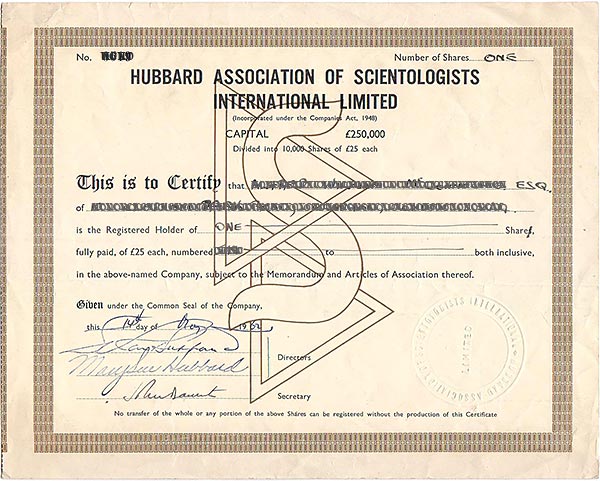
 , PR
, PR & Promo, Income Divisions.”